

Too tight or too loose? Why standard tolerances can be an issue and how custom-made ink cup rings can help.

Does this sound familiar? You remove the ink cup out of the pad printer for cleaning, and "clack" - the expensive doctoring ring falls out, directly into the sink or worse - onto the floor.
Or the opposite? The ring is so tightly fitted, that you can hardly get it out to change it without using force.
Both scenarios are frustrating in everyday's production. They cost time, nerves, and often real money (e.g., when the ceramic breaks).
In this article, we show why "standard fits" are often insufficient and how we make our customers' daily work easier through precise customization.

The dilemma of a fit: physics and tolerances
A ink cup system only works perfectly if the base (ink cup) and the doctoring ring (ceramic/carbide) are compatible. But this is where things often clash:
Different materials: Plastic or aluminum expand differently when heated than ceramic.
Manufacturing tolerances: A "90mm ring" is 90mm in the catalog. In reality, however, a hundredth of a millimeter often determines whether it jams or wobbles.
Practical example: What happens when the ring falls out during washing?
Recently, a customer contacted us who had a specific problem with his original ink cups (plastic).

The problem wasn't the print quality, but the handling during cleaning:
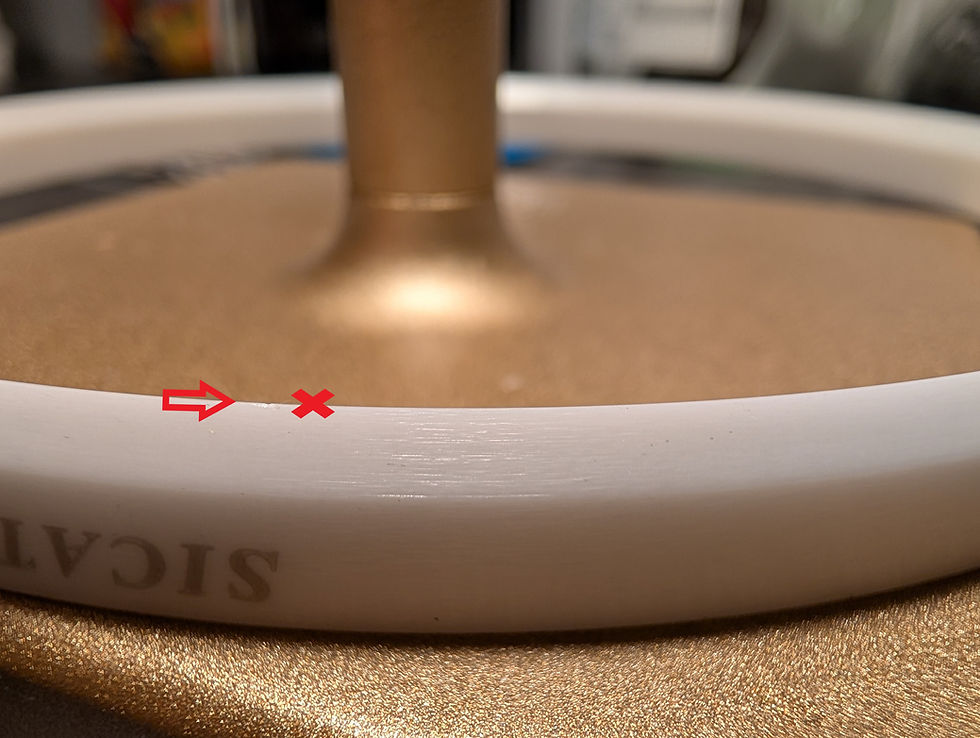
The tungsten ring was so loose in the housing that it constantly fell out on its own during washing in the cleaning.
The consequences: High risk of damage (cracks upon impact) and loss of time.
Reinstalling the ring was fiddly. It would easily get stuck or fall out again before the ink cup system was mounted. This cost employees valuable time every time they changed colors.
Our solution: Custom-made instead of standard
We listened to the customer and optimized the ring.
Analysis: We simulated the seating in the plastic housing in an ultrasonic bath.
Optimization: We manufactured a series of rings with a minimally increased outer diameter.
Result: The new ring can still be inserted by hand, but now has a so-called "suction fit". It stays securely in the housing through slight friction - even if you turn the pot upside down while washing.
For the customer, this small adjustment meant: no more rings falling out, faster retrofitting, fewer breakages.

And what if the doctoring ring jams? (The opposite case)
Of course, the opposite can also happen: the ink cup ring is so tight that it cannot be replaced (often the case with aluminum pots due to thermal expansion). Here too, the cause is often an excessively tight tolerance of the original part.
Instead of hitting the ink cup with a hammer (please don't!), the following often helps:
Heat the aluminum body so that it expands.
Switch to rings from Tampo-Rings.eu , which are manufactured with a tolerance that takes thermal expansion into account.
Conclusion. Don't settle for "wobbling".
Whether your ink cup ring falls out during washing or gets stuck when changing it - this is not a "law of nature" in pad printing. It is usually a sign of less than optimal tolerances.
At Tampo-Rings.eu, we can manufacture both ceramic and tungsten carbide rings to fit your cups perfectly.
Is it too loose? We'll manufacture in the plus tolerance.
Is it too tight? We'll manufacture in the negative tolerance.
Do you have ink cups and rings that drive your employees to despair? Contact us. We'll solve the fitting problem.


Comments